
Tag

Adolescent Girls investment Plan

April 14, 2026

AGIP at Women Deliver 2026

Events

The AGIP Secretariat, alongside many of our member organisations, will be at the Women Deliver 2026 conference, convening partners and amplifying girl-centred advocacy at a critical moment for gender equality.

AGIP will co-host two key sessions focused on strengthening accountability and safeguarding meaningful engagement for adolescent girls.
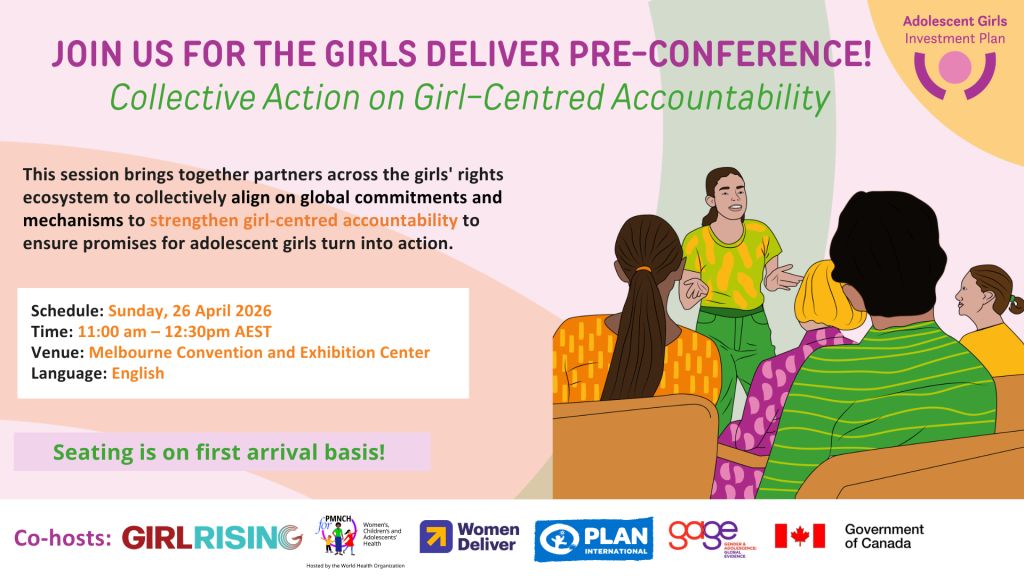
Join us for the Girls Deliver Pre-Conference

🎤 Strategy Session: Collective Action on Girl-Centred Accountability
📍 Girls Deliver Pre-Conference
🗓️ Sunday, 26 April 2026
11:00 AM – 12:30 PM
🎧 Interpretation: Available in French and Spanish via the Women Deliver app (please bring your own earphones)

As global actors convene and collaborate at WD2026, there is a critical opportunity to move beyond rhetorical commitment toward structural, measurable, and girl-centered accountability. Led by AGIP (Women Deliver, Plan International, GAGE and ICRW) in collaboration with Girl Rising and PMNCH, this strategy session will focus on identifying key girl-centred commitments and leveraging existing accountability mechanisms to drive tangible change for adolescent girls around the world when they need it most.
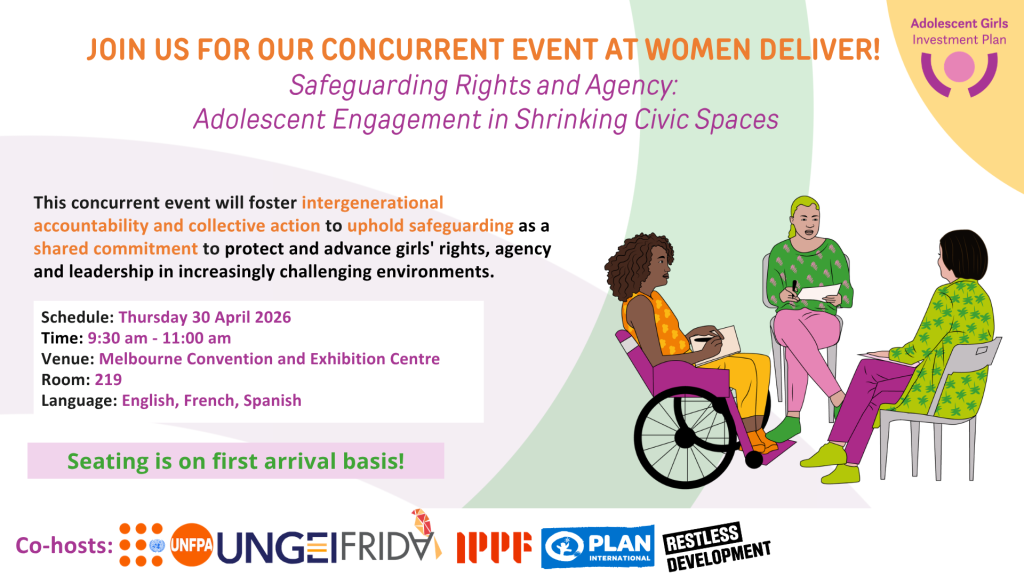
Concurrent Event at Women Deliver

🛡️ Safeguarding Rights and Agency: Adolescent Engagement in Shrinking Civic Spaces
📍 Melbourne Convention and Exhibition Centre, Room 219
🗓️ Thursday, 30 April 2026
9:30 AM – 11:00 AM

Co-hosted with UNFPA and UNGEI, alongside AGIP members FRIDA, IPPF, Plan International and Restless Development, this session reimagines safeguarding as a shared political and ethical responsibility. The event will centre adolescent girls’ perspectives on safety in international development and feminist spaces, while advancing practical recommendations to strengthen safeguarding practices in response to the emerging risks due to increasing civic repression, technology-facilitated harms, and resourcing gaps.

AGIP Members at Women Deliver ’26

AGIP members will be present at Women Deliver 2026, contributing to global conversations through advocacy, research, and girl-led action. Together, we are bringing collective expertise and strengthening the visibility of adolescent girls’ rights, wellbeing and leadership across the conference.
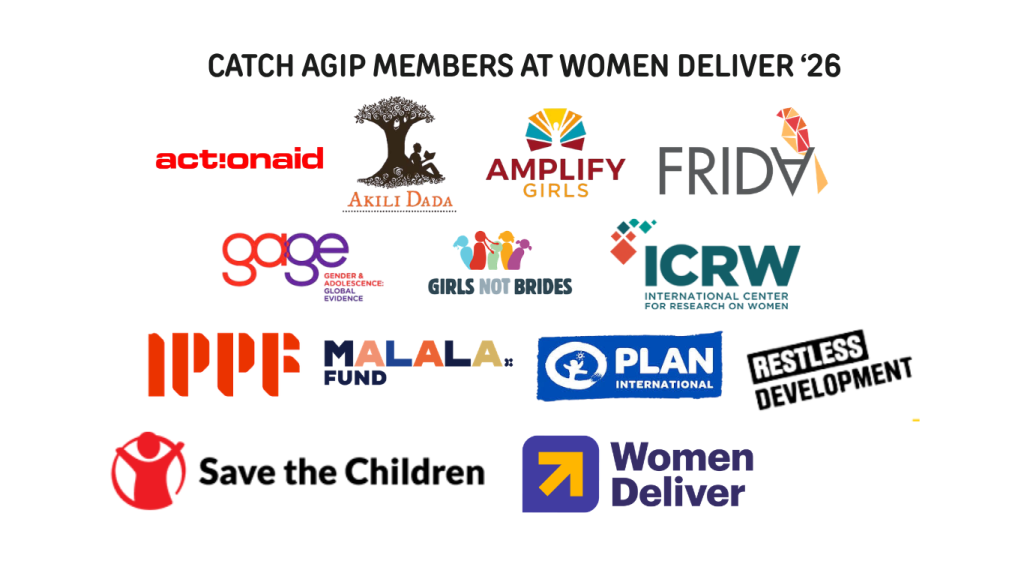
AGIP Members at Women Deliver 2026

If you will be attending the conference and have not yet informed the Secretariat, please reach out to Asha at asha.mukanda@akilidada.org

AGIP Member Meet-Up

We’re excited to be bringing AGIP members together during Women Deliver 2026 for a dedicated Members Meet-Up on 28 April. This will be an opportunity to connect, share insights, and strengthen collaboration across the coalition.

Invitations will be shared directly with members please keep an eye out for further details.

Explore AGIP Resources at Women Deliver

Dive deeper into the evidence, insights, and advocacy shaping our work at Women Deliver 2026:

Call to Action

The alarming decline in funding, growing political and social pushback, and the continued exclusion of girls from decision-making threaten decades of progress.

Now is the time for governments, donors, and global actors to double down on commitments, increase investment in adolescent girl-centred initiatives, and strengthen accountability for sustained impact.

👉 Explore the resources above and join us in driving action for adolescent girls in all their diversity worldwide.

Stay connected

August 22, 2025

Girls’ Leadership in Action: Celebrations and Lessons from AGIP’s first Adolescent Girls Advisory Committee

Events

Zoom
12 August 2025
90 Minutes

About the Webinar

On International Youth Day, AGIP and its Girl Advisors hosted a girl-led event titled ‘Girls’ Leadership in Action: Celebrations and Lessons from AGIP’s First Adolescent Girls Advisory Committee’ to celebrate intergenerational leadership and inspire action toward shifting power to adolescent girls.

Co-facilitated by AGIP Girl Advisor Bui Y Nhi and Youth Engagement & Advocacy Specialist Pooja Singh, the webinar spotlighted lessons, successes, and actionable recommendations from AGIP’s Adolescent Girls Advisory Committee (AGAC).Speakers included Anya Gass (Plan International), Gloria Micheni (AMPLIFY Girls), Joy Zawadi (Akili Dada & AGIP Co-chair), and Girl Advisors Luisa Guzmán, Rushna Zubair, and Sharly Misati.

The key highlight of the event was the launch of the AGAC Handbook, co-created with AGIP’s first cohort of Girl Advisors.

The handbook captures two years of reflections, lessons, and recommendations for organisations embedding girl advisory bodies in their decision-making.

March 12, 2025

Towards Inclusive Systems: Understanding Adolescent Girls’ Engagement, Challenges, and Demands for System-led Accountability ​

Research, What We Do

 Adolescent girls must be at the heart of policies and decisions that shape their lives. To drive meaningful change, they need the skills, resources, and platforms to amplify their voices, hold governments accountable, and influence decision-making processes.

This research, in partnership with ICRW Asia, presents an Accountability Framework co-developed with adolescent girls from India, Nepal, Cambodia, Kenya, Tanzania, Cameroon, and Mexico. It explores:
✔️ The mechanisms girls are using to hold systems accountable to their commitments.
✔️ The challenges and opportunities they face in engaging with decision-makers.
✔️ A model accountability platform designed by adolescent girls, adaptable across different countries.
✔️ Key recommendations to strengthen system accountability to adolescent girls’ needs.

This report is a valuable resource for policymakers, practitioners, and organizations seeking to centre adolescent girls in governance and decision-making. It highlights the power of adolescent-led accountability and provides a roadmap for ensuring their voices shape policies that affect them.

Download the report in English, Spanish and French.

March 12, 2025

Investing in Adolescent Girls: Mapping the Donor Landscape (2022 Update)

Research, Stay Updated, What We Do

The 2022 update of the “Investing in Adolescent Girls” report provides a comprehensive review of global bilateral donor funding dedicated to adolescent girls. The analysis reveals both progress and persistent challenges in achieving equitable and sustainable investments for this demographic. 

This research, part of the AGIP-GAGE series Investing in Adolescent Girls, maps the latest donor Official Development Assistance (ODA) flows, examining funding gaps, trends, and donor priorities while identifying actionable recommendations to ensure robust investments in adolescent girls’ well-being and development. 

Download the full research report here or the webinar report here.

Learn more about AGIP Research here.

February 26, 2025

Resisting the rollback: Strengthening action on girl-centred accountability

Events

UNFPA
14 March 2025
3:00pm  GMT-4 (New York, Toronto)
120

AGIP’s Event at the 69th Commission on the Status of Women (CSW69)


Co-hosts: Adolescent Girls Investment Plan, Government of Canada, Government of Sierra Leone, UNFPA
Schedule: 14th March, Friday, 15:00-17:00 EST (including 30 mins for refreshments and networking)
Venue: Orange Café at UNFPA Headquarters – 605, 3rd Avenue, New York City
Livestream and interpretation: The event will be live-streamed in English with interpretation in French and Spanish. Register here using this link

In-person attendees: Please review the participant briefing here.

Background Context

The 30th anniversary of the Beijing Platform for Action (BPfA) comes at a critical juncture
marked by shifting political leadership, increasing rollbacks on girls’ rights, and shrinking resources for
social development.


As world leaders convene at CSW69 in March 2025, the Adolescent Girls Investment Plan (AGIP) calls
for renewed accountability on girl-centred commitments made in the BPfA and subsequent global
policy frameworks. This moment demands urgent action to safeguard and advance investments in
adolescent girls’ rights, ensuring their meaningful inclusion in formal accountability mechanisms.

Over the past two years, AGIP has been working closely with governments and other allies to establish
a dedicated multi-stakeholder group that champions girls’ leadership and girl-centred accountability.
At the Summit of the Future Action Days in September 2024, AGIP launched the Girl-Centred
Accountability Charter
and introduced its first Global Accountability Champions from Canada and
Sierra Leone. [Read more here.]

Event Overview 

This event will spotlight the critical need for girl-centred accountability mechanisms, featuring:

  • The launch of AGIP-ICRW latest research publication on girl-centered accountability.
  • A multi-stakeholder panel discussion on strategies to protect and advance girls’ inclusion in
    accountability processes.
  • Spotlight interventions sharing key recommendations to strengthen girls’ participation in
    formal accountability frameworks.

Attendees will also be invited to endorse the Girl-Centred Accountability Charter, a concise eight
point framework
urging stakeholders to move beyond commitments and take concrete action in
adopting girl-centred
accountability.

Call to action

  • More governments express willingness to become Champions and sign-on to the Girl
    centred Accountability Charter.
  • More girl-centered organizations and UN entities engage with the topic of accountability,
    embed it into their own advocacy, and endorse the Girl-Centered Accountability Charter.
  • More girls, youth, and sector peers gain insights from the latest AGIP research on ‘Investing
    into Adolescent Girls’ and ‘Girl-led accountability’ to use in their own advocacy.

✅ GOVERMENTS: Urgently reaffirm and strengthen girl-centred commitments and champion accountability.

✅ DONORS: Increase flexible, multi-year, evidence-informed investment for adolescent girls and girl-led organisations.

✅ ALLIES: Walk the talk on meaningful inclusion, and accountability with and for adolescent girls.

November 12, 2024

Resourcing girls: The potential and challenges of girl- and youth-led organising

Research, Stay Updated, What We Do

Young people have been hailed as torchbearers of gender equality and as key actors in identifying and implementing solutions our world urgently requires. This said, understanding how girl- and youth-led organisations operate and their positioning within the ecosystem of gender equality and social change efforts requires careful examination. This report explores the experiences of girl-and youth-led work across low-and middle-income country contexts, and aims to understand the characteristics, contributions, and challenges of girl-and youth-led organisations. It highlights the global focus on gender equality and girls’ rights, emphasizing the increasing visibility of these issues in development commitments yet the complexities in translating these into tangible benefits for girls.

It draws on a rapid evidence review of secondary literature and key informant interviews with girl-and youth-led organisation members, intermediary organisations involved in funding girl- and youth-led groups and monitoring and evaluation experts to understand the contributions and impact of girl-and youth-led initiatives within the broader ecosystem of adolescent and youth empowerment and development as well to investigate the challenges they face in carrying out and expanding their work. The report concludes with reflections and key recommendations stemming from the research.

Read More

September 19, 2024

Beyond commitments: Championing a new Girl-Centred Accountability Charter

Advocacy, What We Do

The Girl-Centered Accountability Charter, launched at the Summit of the Future Action Days 2024, is the keystone of AGIP’s Global Accountability Champions Platform. The Charter outlines 8 actions for governments to model and promote accountability with and for adolescent girls in global advocacy and policy platforms.  

Governments which sign the Charter become ‘Accountability Champions’ and make a public pledge to be accountable to their girl-centred commitments, lead by example, and influence other powerholders to practice accountability.  

Young people, UN bodies and girl-centered organisations can also support the initiative by endorsing the Charter and show solidarity with adolescent girls globally.  

Download the Event Summary report.

Read More

January 11, 2024

International philanthropy needs a strategy for human rights, well-being, justice and peace

From our Members, Stay Updated

Reflections from Shift The Power Global Summit by Pooja Singh, Girl and Youth Engagement Specialist, AGIP

Recently, I had the great privilege to attend the Shift The Power Global Summit in Bogotá, Colombia as a GFCF travel grant recipient. As I sit in the comfort of home reflecting on the whirlwind experience of the Summit, I realize there is much to celebrate and learn from, both in terms of how the Summit was organized and what each participant brought to the convening.

This reflection would not be complete without gratitude to TerritoriA and the Global Fund for Community Foundations (GFCF) for making all the Visa-related information and documents available in a simplified, timely, and accessible format.  Having had the opportunity to attend other conferences in the past, this was the smoothest process I have experienced so far.

The overall Summit design remains a highlight for me. With a late start on Day 1 and 5 pm closures, long lunch breaks, plenty of coffee breaks, limited number of parallel sessions, and fun reception experiences on all three days, I managed to not just engage with the content but also absorb and retain it. Moreover, the intentional pace of the Summit allowed me to interact with people beyond their job and project descriptions, leaving me with a sense of newfound friendships within the feminist allyship that I really cherish at present.

Shift the Power is a mobilizing force that seeks to highlight, harness, resource, legitimize and join up these new ways of “deciding and doing” that are emerging around the world under the larger umbrella of movement generosity so that it can galvanize a vision of a good society and serve as a force for genuine and lasting change.”

The Summit brought together 700 people from 70 countries to contribute to this global conversation on reshaping international funding systems to be more locally led and owned, and for communities to be in charge of their development.

Key notes from the Summit (Notes are not direct quotes but have been paraphrased)

  1. Nana Afadzinu, West Africa Civil Society Institute [Ghana]: Drop the logos, egos, and siloes- together we can do so much more.
  2. Magda Pocheć, FemFund [Poland]: Five strategies on power shifting: intersectional organizing, facilitating solidarity amidst different communities, value local change, regenerative activism, and transformative leadership.
  3. Kelly Bates, Interaction Institute for Social Change [USA]: The skills required for healing are not soft skills. They are deeply necessary for life on a planet that is deeply suffering.  
  4. Sohier Assad,  Rawa Creative Palestinian Communities Fund [Palestine]: The story of Gaza is a story of colonization and colonization is tied with capitalism. It shows whose bodies have been exploited to serve the economic interests of those holding the most power.
  5. Amibika Satkunanathan, Neelan Tiruchelvam Trust [Sri Lanka]: There is an urgent need to acknowledge that structural violence exists within the development sector. It is critical to ask if our philanthropy is truly dismantling such power structures or reinforcing them?
  6. Marta Ruiz, Journalist and former Commissioner of Truth [Colombia]: Peace building is not just an agreement. Empathy, justice healing, and reconciliation in peace building work is essential.  Read Marta Ruiz’s Summit keynote address here.
  7. Barry Knight, GFCF [UK]: Data collection needs to move from being a cold, bureaucratic process towards centring emotions and moral imagination in how impact and success is measured. At present, the donors are asking for the wrong data.
  8. Marie-Rose Romain Murphy, Haiti Community Foundation [Haiti]: Persistence is power, and hope is a strategy. International donors need to reflect on how they impact the self-reliance and local expertise when extending aid without centering local leadership.
  9. Rita Thapa, founder of Tewa [Nepal]: International aid actors need to reflect on the power structure they reinforce through their practices.  This a critical need to reassess who we feel accountable towards. Watch this video with Rita Thapa’s take on #ShiftThePower.
  10. Biraj Patnaik, National Foundation for India [India]:  Can we really shift power without shifting the economic system? Geo-politics can trump all solidarity and there is a need to continue speaking truth to power.
  11. Hibak Kalfan, NEAR Network [USA]: Donors and CSOs need to humble themselves and truly reflect on whether their interventions actually work and if not, remain open to learning and leaning in on community knowledge and solidarity. Always ask: how can I help you?

While we were discussing different ways in which power is concentrated and exercised, the current state of world affairs with worsening war, conflicts, and genocide did not go unnoticed. There was a clear understanding that the geo-politics and economic interests of those holding the most power lacks clear understanding of human rights and well-being, humanitarian justice, and peace. The powerlessness of international institutions in de-escalating the situation and meditating peace has never been more evident. The Summit participants also clearly articulated the inherent issues with how the international philanthropy currently operates and raised several challenging recommendations for the philanthropists and grant-makers to reflect on their practices and adopt a more community-centric approach that prioritizes local leadership.

While the realities are dark, the Summit was an encouraging space to cross-learn on ways to continue challenging the power structures in our homes, organizations, and communities to whatever extent possible because hope is a strategy, and we need to practice what we preach.

Check out our Adolescent Girls Advisory Committee, Call to Action and past advocacy activities to learn more about how AGIP is working to shift the power and resources to adolescent girls!

February 24, 2025

Investing in Adolescent Girls: Mapping the Donor Landscape (2022 Update)

Events

25 February 2025
2:00pm  GMT
90 minutes

A research launch webinar hosted by AGIP and GAGE, featuring expert presentations, civil society insights, and interactive discussions. 

With reflections from: Akili Dada, AWID Young Woman Leader, OECD Development Center, Peace Sisters and Plan International

The Gender and Adolescence: Global Evidence (GAGE) program, in partnership with the Adolescent Girls Investment Plan (AGIP), presents its latest research on global funding supporting adolescent girls. The third in the AGIP-GAGE series ‘Investing in Adolescent Girls’, maps the latest published data on donor official development assistance (ODA) flows, examines critical funding gaps, trends, and donor priorities as mapped onto Sustainable Development Goals (SDG) domains, while identifying actionable pathways to ensure robust investments in adolescent girls’ well-being and development. 

  • To launch the GAGE-AGIP research findings on donor funding trends for adolescent girls, connecting it to the current global moment and AGIP’s Accountability Champions Platform. 
  • To foster critical reflection and dialogue among stakeholders on how to advance investments in adolescent girls and hold governments accountable to their funding commitments. 

Download the report here.

December 11, 2024

Girls on the Agenda and at the Table

Events

6 December 2024
2:00pm  GMT
90 minutes

Enabling power-sharing in decision-making processes through Girl Advisory models

Organizing Partners: AGIP, EMpower – The Emerging Markets Foundation & Global Fund for Women

This webinar, organised by Girl Advisors of the Adolescent Girls Investment Plan (AGIP) on 6th December 2024, celebrated successes, shared valuable lessons, and offered actionable recommendations from the Girls Advisory models of AGIP, EMPower – The Emerging Markets Foundation, and the Global Fund for Women.  

The event also engaged community-based mentors to spotlight the need for in-person safety and learning support and two AGIP board members to underline the need for intergenerational leadership in the current context of increasing roll backs on girls’ rights.